Fashion retailers face a persistent challenge that costs them billions annually: sizing inconsistencies that lead to returns, frustrated customers, and abandoned carts. With online fashion sales continuing to surge, the inability to try items on before buying has made accurate size recommendations more critical than ever for maintaining customer satisfaction and reducing operational costs.
Modern fashion retailers are turning to automated size and fit recommendation systems to solve this problem, using advanced technology to deliver personalized sizing guidance that rivals the in-store experience. These intelligent systems analyze customer data, body measurements, and product specifications to provide accurate fit predictions across diverse product lines and brands.
What are automated size and fit recommendations in fashion retail?
Automated size and fit recommendations are AI-powered systems that analyze customer data and product specifications to suggest the most appropriate size for individual shoppers. These systems eliminate guesswork by processing body measurements, purchase history, and return patterns to deliver personalized sizing guidance.
The technology works by creating detailed customer profiles that include physical measurements, fit preferences, and brand-specific sizing tendencies. When a customer views a product, the system instantly compares their profile against the item’s measurements and cut to generate a confidence-rated size recommendation. Advanced systems also account for fabric stretch, seasonal fit variations, and style-specific adjustments.
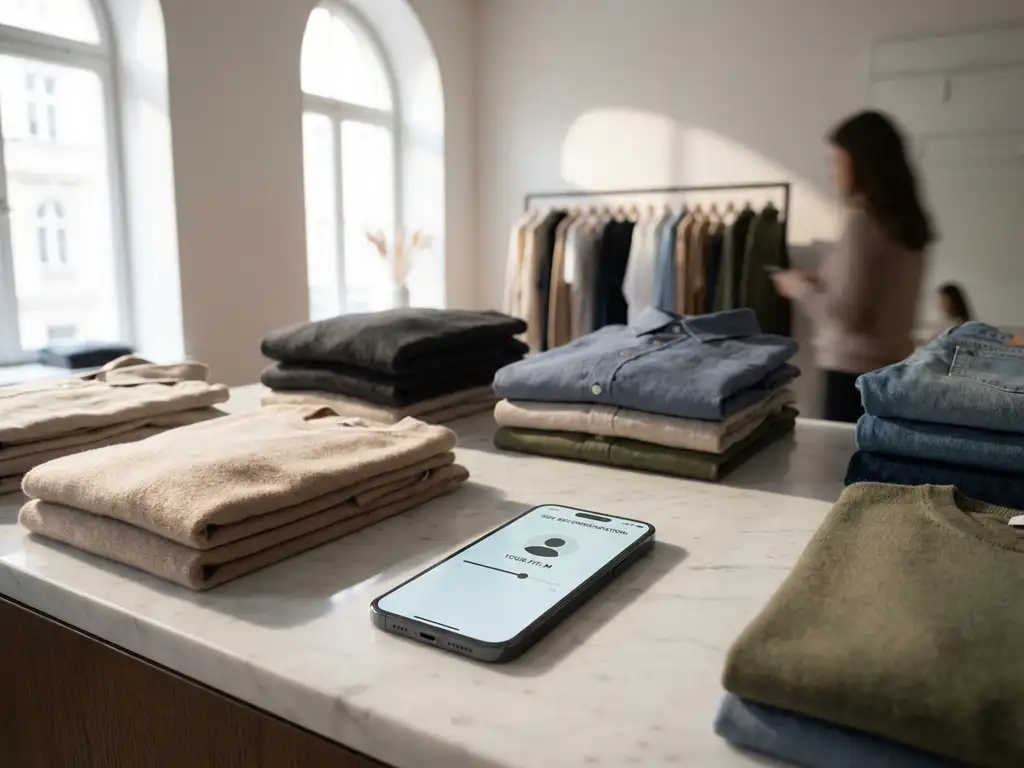
These recommendations typically appear as clear size suggestions with confidence indicators, such as “We recommend size M with 95% confidence” or “This item runs small; consider sizing up.” Some systems also provide fit previews, showing how different areas—such as the chest, waist, or length—will fit based on the customer’s measurements.
How do fashion retailers collect customer data for size recommendations?
Fashion retailers gather sizing data through multiple touchpoints, including onboarding questionnaires, purchase history analysis, return-reason tracking, and integration with sizing apps or virtual fitting tools. This multi-source approach creates comprehensive customer profiles that improve recommendation accuracy over time.
The most effective data collection starts during account creation, when customers enter basic measurements, height, weight, and fit preferences through guided questionnaires. Smart retailers make this process engaging by explaining how the data improves the shopping experience and offering immediate value, such as personalized size charts.
Behavioral data provides equally valuable insights. Every purchase, return, and exchange tells a story about fit preferences. When customers return items marked “too large” or “too small,” this feedback trains the system to make better future recommendations. Some retailers also track which size guides customers view and how long they spend reviewing sizing information.
Progressive retailers integrate with third-party sizing technologies that use smartphone cameras for body scanning or partner with apps that store customer measurements across multiple brands. This approach reduces data-collection friction while providing more accurate measurements than self-reported data.
What technology powers automated fit recommendation systems?
Machine learning algorithms, computer vision, and predictive analytics form the technological backbone of automated fit recommendation systems. These technologies process vast datasets of customer measurements, product specifications, and fit feedback to generate increasingly accurate size predictions.
Machine learning models analyze patterns in customer data to understand how different body types fit into various brands and styles. The algorithms continuously learn from new purchases and returns, identifying subtle correlations, such as how customers with certain measurements typically prefer looser fits in specific categories or how seasonal preferences affect sizing choices.
Computer vision technology enables advanced features such as virtual try-ons and body scanning through smartphone cameras. These systems can extract accurate measurements from photos and create 3D body models that predict how garments will fit and drape on individual customers.
The most sophisticated systems integrate with product information management platforms to access detailed garment specifications, including measurements, fabric properties, and construction details. This integration allows the system to account for factors such as fabric stretch, shrinkage potential, and style-specific fit characteristics that static size charts cannot capture.
How accurate are automated size recommendations compared to traditional sizing?
Well-implemented automated size recommendation systems achieve 85–95% accuracy rates, significantly outperforming traditional size charts, which typically deliver 60–70% accuracy. The improvement comes from personalization that accounts for individual body measurements, fit preferences, and brand-specific sizing variations.
Traditional sizing relies on standardized measurements that often fail to account for body-shape variations, personal fit preferences, or brand inconsistencies. A size medium from one brand may fit completely differently than a medium from another, leaving customers to guess based on limited information.
Automated systems excel because they learn from collective customer behavior and individual preferences. When thousands of customers with similar measurements purchase and provide feedback on specific items, the system builds a detailed understanding of how that item truly fits across different body types.
The accuracy gap becomes even more pronounced for brands with international customer bases, where sizing conventions vary significantly between regions. Automated systems can seamlessly translate between sizing standards and account for regional fit preferences—something static size charts cannot do.
What are the main benefits of automating size recommendations for retailers?
Automated size recommendations deliver measurable benefits, including a 20–40% reduction in size-related returns, a 15–25% increase in conversion rates, and improved customer satisfaction scores. These systems also provide valuable data insights that inform product development and inventory planning decisions.
Return reduction represents the most immediate financial impact. Size-related returns cost retailers significantly through processing fees, restocking labor, and potential inventory markdowns. When customers receive accurate size recommendations, they keep more items, improving profitability per transaction.
Conversion improvements stem from reduced purchase anxiety. Customers who feel confident about sizing are more likely to complete purchases, especially for higher-priced items, where return hassles feel more significant. Marketing automation systems can track these conversion improvements and trigger follow-up campaigns based on sizing confidence levels.
The data generated by sizing systems provides strategic value beyond immediate sales. Retailers gain insights into customer body-type distributions, fit-preference trends, and product-specific sizing issues. This information guides design decisions, helps optimize inventory allocation, and identifies opportunities for new size ranges or fit variations.
How can fashion retailers implement automated sizing solutions?
Fashion retailers can implement automated sizing through integrated software solutions, third-party APIs, or custom-built systems, depending on their technical resources and specific requirements. The implementation process typically involves data integration, system training, and a gradual rollout with performance monitoring.
Most retailers start with third-party solutions that offer proven algorithms and quick deployment. These platforms integrate with existing e-commerce systems through APIs and provide pre-built recommendation widgets that can be customized to match brand aesthetics. Popular solutions include specialized sizing platforms that focus exclusively on fit technology.
Implementation success depends heavily on data quality and collection strategy. Retailers need systems to capture customer measurements, track purchase outcomes, and process return feedback. Customer data platforms play a crucial role in consolidating this information from multiple touchpoints and ensuring data accuracy.
The rollout phase should include A/B testing to measure impact on key metrics such as conversion rates and return rates. Smart retailers start with their best-selling categories or highest-return items to maximize initial impact, then expand the system across their full product catalog as confidence and data quality improve.
How Deployteq helps with automated fashion recommendations
We enable fashion retailers to implement sophisticated automated sizing recommendations through our integrated customer data platform and advanced segmentation capabilities. Our platform consolidates customer measurement data, purchase history, and return patterns to create comprehensive profiles that power accurate size recommendations.
Our solution provides fashion retailers with:
- Unified customer data collection across all touchpoints, including website interactions, purchase history, and return feedback
- Real-time segmentation based on body measurements, fit preferences, and sizing behavior patterns
- Automated campaign triggers that deliver personalized sizing guidance and fit recommendations via email, SMS, and web
- Advanced analytics that track recommendation accuracy and identify opportunities for sizing optimization
Ready to transform your fashion retail experience with intelligent size recommendations? Book a demo to see how our platform can reduce returns, increase conversions, and deliver the personalized sizing experience your customers expect.