RFM modelling is a customer segmentation technique that scores customers based on three behavioural dimensions: how recently they purchased, how often they purchase, and how much they spend. It improves targeting accuracy by replacing broad demographic assumptions with actual purchase behaviour, so marketers can prioritise high-value customers, re-engage those drifting away, and stop wasting budget on audiences unlikely to convert. The sections below unpack how RFM scoring works, how it differs from traditional segmentation, and when to combine it with other predictive models.
How does RFM modelling actually segment customers?
RFM modelling segments customers by assigning a score to each of the three dimensions – Recency, Frequency, and Monetary value – based on their transaction history. Each customer receives a combined RFM score, and those scores are used to group customers into meaningful behavioural tiers such as Champions, Loyal Customers, At-Risk, and Lapsed. The result is a segmentation framework built entirely on what customers actually do, not who marketers assume them to be.
In practice, each dimension is scored on a scale (commonly 1 to 5). A customer who purchased yesterday, buys every two weeks, and consistently spends above average will score highly across all three. A customer who last purchased eight months ago, has only ever bought once, and spent a low amount will score at the opposite end. The combination of these three scores places each customer into a distinct segment.
What makes RFM powerful is its simplicity and immediacy. You do not need complex modelling tools to get started. A clean transaction dataset is enough to generate meaningful segments that marketing teams can act on straight away.
What types of customer behaviour does RFM scoring measure?
RFM scoring measures three specific types of purchase behaviour: the time elapsed since a customer’s last transaction (Recency), the total number of transactions within a defined period (Frequency), and the cumulative or average spend across those transactions (Monetary value). Together, these three signals create a behavioural fingerprint for every customer in your database.
Recency is often the strongest predictor of future engagement. A customer who bought last week is far more likely to respond to a campaign than one who last purchased two years ago. Recency scores help marketers identify who is warm and ready to convert versus who needs a re-engagement sequence before a direct offer makes sense.
Frequency reveals loyalty patterns. High-frequency buyers are your repeat customers, the ones who have formed a genuine habit around your brand. Low-frequency buyers may be one-time purchasers or seasonal shoppers who need nurturing to build a longer relationship.
Monetary value highlights revenue contribution. This dimension is particularly useful for identifying VIP customers who generate disproportionate revenue and deserve premium treatment, as well as low-spend customers who may need different incentives to increase their basket size.
How does RFM analysis improve targeting accuracy in campaigns?
RFM analysis improves targeting accuracy by ensuring every campaign speaks to a customer’s actual relationship with your brand. Instead of sending the same message to your entire database, RFM lets you tailor the offer, tone, and timing to match where each customer sits in their lifecycle. This reduces irrelevance, lowers unsubscribe rates, and increases conversion.
Consider a retail brand running a reactivation campaign. Without RFM, they might send a 20% discount to everyone who has not purchased in six months. With RFM, they can identify customers who were previously high-frequency and high-spend but have gone quiet – and send those customers a personalised, high-value offer worth the investment. Customers who were always low-frequency and low-spend receive a lighter-touch message, or are excluded entirely to protect margin.
For travel and entertainment brands, RFM is equally valuable. A loyalty programme can use Frequency scores to identify guests approaching a tier threshold and trigger a targeted nudge. A streaming platform can use Recency to catch subscribers showing early signs of churn before they cancel.
The accuracy improvement comes from smarter segmentation logic that is grounded in behaviour rather than guesswork. Campaigns become more relevant by design, not by luck.
What’s the difference between RFM modelling and traditional segmentation?
The key difference is that traditional segmentation groups customers by static attributes such as age, location, or acquisition channel, while RFM modelling groups them by dynamic purchase behaviour. Traditional segments describe who a customer is. RFM segments describe what a customer does and how valuable they are right now.
Traditional segmentation is useful for broad audience targeting and brand positioning. It helps marketers understand the demographic profile of their customer base. But it has a significant limitation: two customers with identical demographic profiles can have completely different purchase behaviours. One might be a weekly buyer with a high lifetime value. The other might have purchased once two years ago and never returned. Traditional segmentation treats them the same. RFM does not.
RFM also updates automatically as customer behaviour changes. A customer who was classified as At-Risk last quarter can move into the Champions segment if they increase their purchase frequency. Traditional segments based on fixed attributes rarely reflect this kind of movement. For marketers managing unified customer data, RFM provides a living view of customer value rather than a static snapshot.
When should marketers use RFM alongside other predictive models?
Marketers should use RFM alongside other predictive models when they need to go beyond describing past behaviour and start anticipating future actions. RFM is descriptive by nature – it tells you what a customer has done. Predictive models such as next-best-offer, churn propensity, and CLV forecasting tell you what a customer is likely to do next. Combining both gives you a far more complete picture.
A practical example: RFM identifies a customer as At-Risk based on declining recency and frequency. A churn propensity model then scores the likelihood that this customer will lapse entirely within 30 days. Together, these signals allow the marketing team to prioritise which At-Risk customers deserve a high-value retention offer versus which ones are likely to return naturally without intervention.
Next-best-offer modelling works particularly well layered on top of RFM. Once you know a customer’s value tier from their RFM score, a next-best-offer model can determine which product or service is most likely to resonate with them at that moment. This combination is especially effective in retail, finance, and travel sectors where product catalogues are large and personalisation directly impacts revenue.
The rule of thumb: use RFM to segment and prioritise, and use predictive models to decide what to say and when to say it.
How do you get started with RFM modelling in a marketing platform?
Getting started with RFM modelling requires three things: a clean transaction dataset, a defined scoring framework, and a marketing platform capable of activating those scores in campaigns. The process itself is straightforward once the data foundations are in place.
- Consolidate your transaction data. RFM scoring relies on purchase history. If your data is fragmented across multiple systems, unify it first. You need a single record per customer showing purchase dates, frequency, and spend values.
- Define your scoring scale and time window. Most practitioners use a 1-to-5 scale per dimension and a 12-month rolling window, though this varies by sector. High-frequency retail brands may use a 90-day window. Travel brands with longer booking cycles may extend to 24 months.
- Assign scores and build your segments. Calculate each customer’s R, F, and M scores individually, then combine them to create named segments. Common segment labels include Champions (high across all three), Loyal Customers (high F and M, moderate R), At-Risk (previously high, now declining R), and Lapsed (low across all three).
- Map segments to campaign triggers. Each RFM segment should have a corresponding campaign strategy. Champions receive VIP treatment and early access. At-Risk customers receive re-engagement sequences. Lapsed customers receive win-back campaigns with a clear incentive.
- Review and refresh scores regularly. RFM is only useful if it stays current. Set a cadence to recalculate scores, whether weekly, monthly, or quarterly depending on your purchase cycle.
The biggest barrier most teams face is not the model itself but the data quality behind it. Disconnected marketing data makes accurate RFM scoring impossible. If your transaction data lives in separate silos, scoring will be incomplete and your segments will be unreliable. Solving the data foundation first is always the right starting point. Once your email marketing campaigns are connected to live RFM scores, the impact on relevance and revenue becomes clear quickly.
How Deployteq powers RFM modelling for smarter campaigns
We built RFM modelling directly into our Customer Data Platform so marketers can move from raw data to activated segments without needing a data science team. Here is what that looks like in practice:
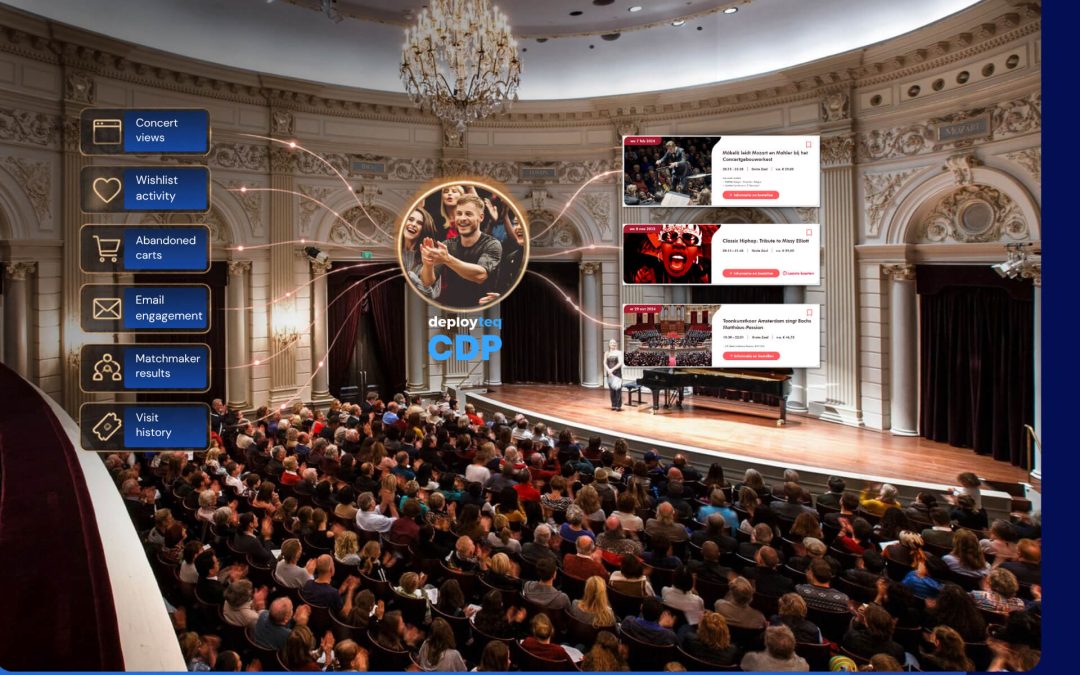
- Unified customer profiles: Our CDP consolidates transaction data, behavioural signals, and channel interactions into a single customer view, giving RFM scoring the clean, complete data it needs to be accurate.
- Built-in RFM scoring: Scores are calculated automatically and updated on a rolling basis, so your segments always reflect current customer behaviour rather than a static snapshot.
- Predictive modelling layered in: Alongside RFM, we offer next-best-offer and predictive lifecycle insights, so you can combine behavioural scoring with forward-looking intelligence in the same platform.
- Direct campaign activation: RFM segments activate directly into email, SMS, WhatsApp, push, and web campaigns. No exports, no manual list builds, no lag between insight and action.
- Cross-channel consistency: Whether a customer is in a Champions segment or an At-Risk sequence, the experience stays consistent across every channel they interact with.
If your current platform cannot connect your customer data to your campaigns in real time, you are leaving targeting accuracy on the table. Book a demo to see how our CDP and RFM modelling work together inside a single platform.