Email marketing ROI for e-commerce stores is calculated by dividing the revenue generated from email campaigns by the total cost of those campaigns, then multiplying by 100 to get a percentage. Most successful e-commerce brands achieve email marketing ROI between 3,600% and 4,200%, making it one of the highest-performing digital marketing channels.
The key to maximizing your email marketing ROI lies in accurate tracking, proper attribution, and continuous optimization based on performance data. Understanding which metrics matter most and how to measure them effectively will transform your email marketing from a cost center into a revenue powerhouse.
What metrics do you need to calculate email marketing ROI?
To calculate email marketing ROI accurately, you need four essential metrics: total email marketing costs, revenue attributed to email campaigns, conversion rates, and customer lifetime value from email subscribers. These metrics work together to give you a complete picture of your email marketing performance.
Your total costs should include platform fees, design and development time, content creation costs, and any third-party integrations or tools. Don’t forget to factor in the salary costs for team members who manage your email marketing campaigns.
Revenue attribution requires tracking mechanisms that connect email opens, clicks, and conversions back to specific campaigns. This includes direct conversions from email clicks as well as assisted conversions where email played a role in the customer journey.
Conversion rates help you understand how effectively your emails drive action, while customer lifetime value shows the long-term impact of your email marketing efforts beyond the initial purchase.
How do you track revenue from email campaigns?
Track email campaign revenue using UTM parameters, unique promo codes, and dedicated landing pages that connect directly to your analytics platform. This creates a clear path from email engagement to actual sales, giving you concrete revenue data for each campaign.
UTM parameters are the most reliable method for tracking email revenue. Add specific UTM codes to every link in your emails, using consistent naming conventions like “utm_source=email” and “utm_campaign=newsletter_january2026”. This allows your analytics platform to attribute sales directly to email traffic.
Unique promo codes work exceptionally well for e-commerce tracking. Create campaign-specific discount codes that can only be used by email recipients. This method provides 100% accurate attribution since the code can only come from your email campaign.
For businesses using advanced marketing automation, implement pixel tracking and customer journey mapping. These tools track customer behavior across multiple touchpoints, showing you exactly how email campaigns contribute to revenue throughout the entire customer lifecycle.
What’s the difference between email ROI and email revenue?
Email ROI is a percentage that shows your return on investment by comparing revenue to costs, while email revenue is the absolute dollar amount generated from your campaigns. ROI tells you efficiency, revenue tells you scale.
Email revenue is straightforward: it’s the total money your email campaigns generate. If your holiday campaign drives $50,000 in sales, that’s your email revenue for that campaign.
Email ROI puts that revenue in context by comparing it to your costs. If that $50,000 revenue campaign cost $2,000 to execute, your ROI would be 2,400%. This percentage helps you compare the effectiveness of different campaigns regardless of their size or budget.
Understanding both metrics is crucial for strategic decision-making. High revenue with low ROI might indicate inefficient spending, while high ROI with low revenue might suggest you’re not scaling successful campaigns enough.
How do you handle attribution when customers use multiple channels?
Handle multi-channel attribution by implementing first-touch, last-touch, and multi-touch attribution models that assign credit to email marketing based on its role in the customer journey. Most e-commerce stores benefit from a time-decay attribution model that gives more credit to touchpoints closer to the conversion.
First-touch attribution gives full credit to the first channel that brought the customer to your site. If someone discovers your brand through an email campaign and later purchases through direct traffic, email gets 100% credit under this model.
Last-touch attribution does the opposite, crediting the final touchpoint before conversion. This often undervalues email marketing since customers frequently return directly to make purchases after email engagement.
Multi-touch attribution distributes credit across all touchpoints in the customer journey. A customer might discover you through social media, engage with your email campaigns, and convert through a Google search. Multi-touch models assign partial credit to email for its role in nurturing the customer toward conversion.
Time-decay attribution gives increasing credit to touchpoints closer to the conversion. This model recognizes that while early touchpoints create awareness, recent interactions often drive the final purchase decision.
What email marketing ROI benchmarks should e-commerce stores target?
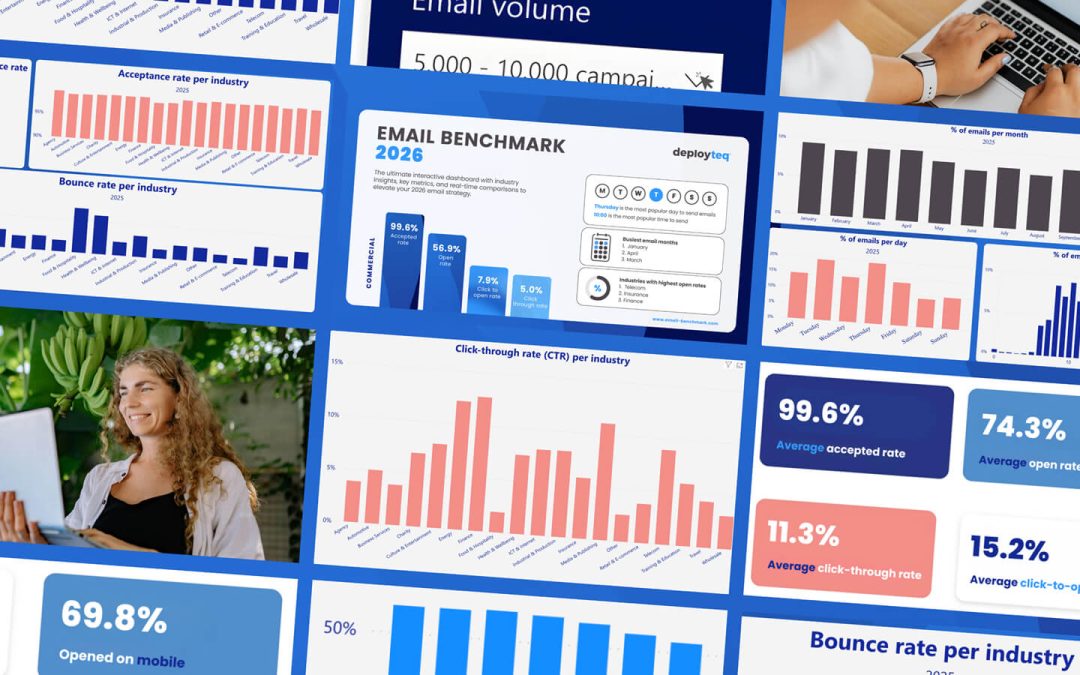
E-commerce stores should target email marketing ROI between 3,600% and 4,200%, which translates to $36-42 in revenue for every dollar spent on email marketing. However, ROI varies significantly by industry, with fashion and beauty often achieving higher returns than electronics or furniture retailers.
Industry benchmarks provide helpful context for your performance goals. Fashion and beauty brands frequently see ROI above 4,000% due to repeat purchases and emotional buying decisions. Food and beverage companies often achieve similar results with loyalty programs and subscription models.
Electronics and technology retailers typically see lower ROI around 2,500-3,000% because of longer purchase cycles and higher consideration periods. Furniture and home goods follow similar patterns due to infrequent, high-value purchases.
Your specific benchmark should also consider your email list maturity and segmentation sophistication. New email programs might start around 2,000% ROI and improve over time, while mature programs with advanced customer data platforms can exceed 5,000% ROI through precise personalization.
How do you improve email marketing ROI over time?
Improve email marketing ROI through advanced segmentation, personalization, automation workflows, and continuous A/B testing of subject lines, send times, and content formats. Focus on increasing both revenue per email and reducing campaign costs through efficiency improvements.
Advanced segmentation dramatically improves ROI by sending relevant content to specific customer groups. Segment by purchase history, browsing behavior, geographic location, and engagement patterns. A customer who frequently buys winter gear should receive different emails than someone who only purchases summer items.
Automation workflows generate higher ROI than one-off campaigns because they deliver timely, relevant messages without ongoing manual effort. Set up welcome series, abandoned cart recovery, post-purchase follow-ups, and re-engagement campaigns that run automatically based on customer behavior.
Continuous testing reveals what resonates with your audience and drives higher conversion rates. Test subject lines, send times, email layouts, call-to-action buttons, and personalization elements. Small improvements compound over time to significantly boost your overall ROI.
Reduce costs by improving list hygiene, optimizing send frequency, and automating manual processes. Clean lists improve deliverability and engagement while reducing platform costs for inactive subscribers.
How Deployteq helps with email marketing ROI measurement
Deployteq provides comprehensive email marketing ROI tracking through our integrated analytics dashboard, advanced segmentation capabilities, and seamless revenue attribution across all customer touchpoints. Our email marketing platform connects directly with your e-commerce data to show exactly how each campaign contributes to your bottom line.
Key features that maximize your email marketing ROI include:
- Real-time revenue tracking with automatic UTM parameter generation and conversion attribution
- Advanced customer segmentation based on purchase behavior, engagement patterns, and predictive modeling
- Automated workflow optimization that adjusts send times and content based on individual customer preferences
- Cross-channel attribution reporting that shows email’s role in multi-touch customer journeys
- A/B testing tools for continuous campaign optimization and ROI improvement
Ready to transform your email marketing ROI? Book a demo to see how Deployteq can help you achieve the 4,000%+ ROI that leading e-commerce brands are already enjoying.