Scattered customer data is one of those problems that rarely announces itself loudly. Instead, it chips away at your results quietly: campaigns underperform, reports contradict each other, and your team spends more time chasing data than using it. If any of that sounds familiar, you are likely already dealing with the consequences of fragmented data. Knowing how to unify customer data starts with recognising the warning signs before they become full-blown crises.
Here are eight signs your customer data is scattered, and what each one is really telling you.
When scattered data quietly sabotages your marketing
The tricky thing about scattered customer data is that it rarely looks like a data problem on the surface. It looks like a deliverability dip, a campaign that missed its targets, or a loyalty programme that feels strangely impersonal. The root cause is the same: your customer data lives in silos, and those silos are costing you revenue.
Before you can fix the problem, you need to name it. These eight warning signs are the clearest signals that your data architecture needs attention.
1: Your customer profiles live in multiple platforms
If your CRM holds one version of a customer, your email platform holds another, and your e-commerce stack holds a third, you do not have a single customer view. You have three. This is the most common starting point for a scattered customer data problem, and it compounds every other issue on this list.
When profiles are fragmented, every decision downstream is based on incomplete information. Segmentation becomes unreliable. Personalisation becomes guesswork. And your team wastes hours manually reconciling data that should be connected automatically.
The practical fix is data unification into a single customer profile that pulls from every source in real time. Until that infrastructure exists, every campaign you run is working with partial information.
2: Segments keep producing irrelevant audiences
You build a segment for high-value customers who have not purchased in 90 days. The results come back, and the audience includes people who bought last week. Sound familiar? When segments produce audiences that do not match their criteria, it is a direct symptom of stale or conflicting data feeding your segmentation engine.
Irrelevant audiences mean wasted spend, lower engagement rates, and customers receiving messages that feel completely off. For retail and e-commerce marketers, this translates directly into suppressed conversion rates and eroded trust.
Smart segmentation depends on data that is clean, unified, and updated in real time. If your segments are consistently off, the problem is upstream from your segmentation tool.
3: Personalisation feels generic across every channel
Personalisation that only uses a first name is not personalisation. It is a mail merge. When your customer data is scattered, you lose the behavioural signals, purchase history, and preference data that make genuine personalisation possible. The result is content that feels generic, even when it technically includes the customer’s name.
For sectors like travel and finance, where customer lifecycles are complex and trust is critical, generic messaging actively damages relationships. A travel brand that cannot reference a customer’s previous destinations or booking window preferences is leaving significant engagement on the table.
True hyper-personalisation requires a unified data layer. Without it, you are personalising with one hand tied behind your back.
4: Reporting numbers never match across tools
Your email platform says the open rate is 28%. Your analytics tool says 19%. Your CRM shows a different revenue attribution entirely. When reporting numbers do not align across tools, it creates decision paralysis. Which number do you trust? Which do you present to leadership?
Mismatched reporting is a classic sign of data unification problems. Each platform is measuring from its own data source, with its own logic, and none of them are talking to each other. The result is a reporting environment where no one is fully confident in the numbers.
Unified data means unified reporting. When every tool draws from the same source of truth, your metrics align and your decisions become faster and more confident.
5: Duplicate contacts inflate your database
A database with 200,000 contacts sounds impressive until you realise 40,000 of them are duplicates. Duplicate records are a direct consequence of data entering your ecosystem from multiple sources without a deduplication layer. The same customer appears under different email addresses, different loyalty IDs, or different platform accounts.
Beyond the vanity metric problem, duplicates inflate your costs, skew your engagement metrics, and mean customers receive the same message multiple times. That last point is particularly damaging for brands in entertainment and retail, where over-messaging leads to unsubscribes.
A proper marketing automation setup with identity resolution built in will deduplicate records and merge profiles automatically, giving you an accurate count and a cleaner database.
6: Customer journeys break at channel handoffs
A customer clicks a promotional email, visits your website, abandons a form, and then receives a welcome email three days later as if none of that happened. Journey breaks at channel handoffs are one of the most visible signs of scattered data. Each channel is operating independently, with no shared context about what the customer has already done.
For CRM and lifecycle marketers, this is a critical failure point. The whole value of cross-channel marketing depends on channels sharing context. When they do not, journeys feel disjointed and customers notice.
Fixing this requires event data flowing in real time across every channel, with a central orchestration layer that knows where each customer is in their journey at any given moment.
7: Consent and preference data is hard to locate
If someone on your team asks “what has this customer consented to?” and the answer requires checking three different platforms, you have a compliance risk and a data problem. Consent and preference data must be centralised, accessible, and current. Scattered consent records create legal exposure and erode customer trust.
This is particularly acute in finance and insurance, where regulatory requirements around consent are strict and the consequences of non-compliance are significant. But it applies across every sector as privacy expectations continue to rise in 2026.
Centralising consent data is not just a legal requirement. It is a trust-building exercise that signals to customers that you handle their preferences with care.
8: New campaigns take weeks to set up
When campaign setup takes weeks rather than days, the bottleneck is almost always data. Your team is spending time extracting lists from one platform, cleaning them in a spreadsheet, uploading them to another, and manually checking for errors before anything goes live. That is not a process problem. It is a data infrastructure problem.
Slow campaign setup means missed windows. In retail, a flash sale campaign that takes two weeks to build is already irrelevant. In travel, a destination promotion that misses the booking window has zero impact. Speed of execution is a competitive advantage, and it starts with data you can actually use without manual intervention.
When your data is unified and your email marketing platform connects directly to it, campaign setup collapses from weeks to hours.
Unify your data before these signs become crises
Each of these warning signs is manageable on its own. But when several appear together, they signal a systemic problem with how your customer data is structured, stored, and activated. The longer fragmented data goes unaddressed, the harder it becomes to course-correct, and the more revenue you leave on the table in the meantime.
The answer to how to unify customer data is not another point solution. It is a platform that brings all your data together, resolves identities, and makes that unified view available across every channel and campaign in real time.
How Deployteq helps with customer data unification
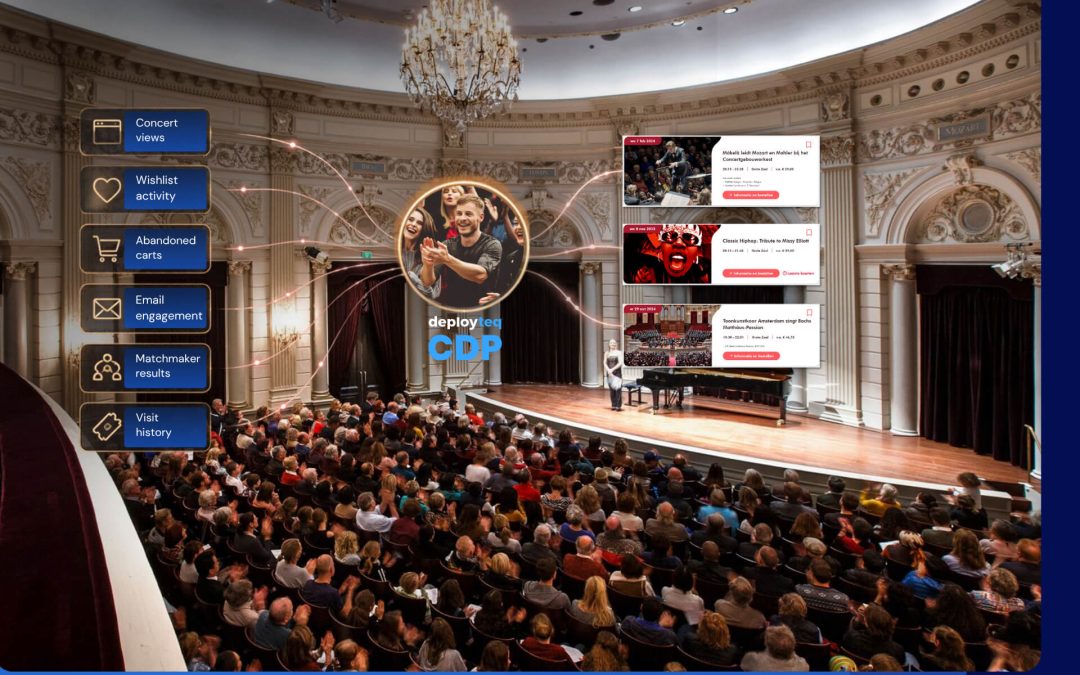
We built our Customer Data Platform (CDP) specifically to solve the problems described above. It is designed for marketers who are done patching together disconnected tools and ready to work from a single, reliable source of truth.
- 360-degree single customer view: Every interaction, purchase, preference, and consent record unified into one intelligent profile per customer.
- Real-time activation: Unified data flows directly into campaigns across email, SMS, WhatsApp, push, and web, with no manual exports or delays.
- Intelligent modelling built in: RFM scoring, next-best-offer recommendations, and predictive insights are available without needing a data science team.
- Hyper-personalisation at scale: With complete profiles, you can build segments and journeys that respond to actual customer behaviour, not assumptions.
- Consent and preference management: All consent data sits in one place, making compliance straightforward and auditable.
If you recognise more than two or three of the warning signs above, it is worth exploring what a proper data unification solution looks like in practice. Book a demo and see how Deployteq’s CDP can turn your scattered data into a genuine competitive advantage.