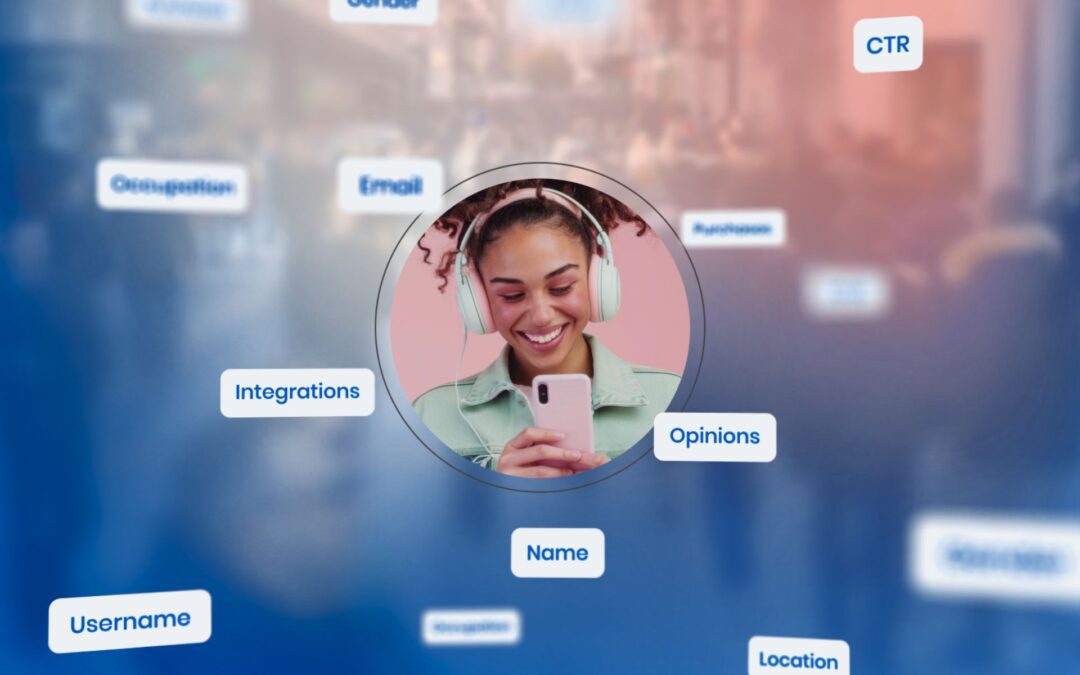
You build a 360-degree customer profile with a CDP by unifying data from every touchpoint — web, email, app, in-store, and beyond — into a single, persistent customer record. The CDP continuously resolves identities across those sources, so every interaction updates the same profile in real time. Here is how that works in practice, and what to watch out for along the way.
What data sources feed into a 360-degree customer profile?
A 360-degree customer profile draws from every channel where a customer leaves a digital or physical trace. That includes behavioural data (web browsing, app usage, email engagement), transactional data (purchases, returns, subscription renewals), CRM records, loyalty programme activity, and third-party enrichment data. The more complete the source map, the sharper the profile.
In practice, the most valuable data sources tend to be:
- First-party behavioural data from your website and app (page views, click paths, time on site)
- Transactional data from your ecommerce platform or POS system
- Email and SMS engagement data (opens, clicks, unsubscribes)
- CRM and support records (contact history, service tickets, account status)
- Loyalty and membership data (points balance, tier, redemption behaviour)
- Offline data (in-store purchases, call centre interactions)
For sectors like travel and retail, offline data is particularly important. A customer who books a holiday online but calls to amend it has a fragmented story unless both interactions land in the same profile. The CDP’s job is to make sure they do.
How does a CDP unify data from different channels into one profile?
A CDP unifies data by resolving multiple identifiers — email address, cookie ID, loyalty number, device ID — into a single customer record through a process called identity resolution. When the same person interacts across different channels, the CDP stitches those touchpoints together under one persistent profile, updating it continuously as new data arrives.
The unification process typically works in three stages:
- Data ingestion: The CDP pulls in raw data from connected sources via APIs, SDKs, or native integrations.
- Identity resolution: It matches and merges records using deterministic matching (same email, same login) or probabilistic matching (shared device signals, behavioural patterns).
- Profile enrichment: It layers on calculated attributes — RFM scores, predicted LTV, next-best-offer signals — so the profile is not just a record of the past, but a basis for future action.
The result is a unified customer profile that any downstream tool — your email platform, your personalisation engine, your paid media stack — can activate against. That is what makes the CDP genuinely useful rather than just another data warehouse.
What’s the difference between a CDP, a CRM, and a DMP for customer profiles?
The key distinction in the CDP vs DMP difference is purpose and data type. A CDP builds persistent, first-party profiles for known individuals and is designed for activation. A DMP handles anonymous, third-party audience segments primarily for ad targeting. A CRM manages relationship records and sales interactions, but typically lacks the real-time data ingestion and cross-channel scope of a CDP.
CDP vs CRM
A CRM is built around managed relationships — contacts, deals, and service history. It is excellent for sales teams tracking pipeline or support teams logging tickets. But it is not designed to ingest real-time behavioural data at scale or resolve identities across anonymous and known touchpoints. A CDP does both, which is why the two tools often complement each other rather than compete.
CDP vs DMP
The CDP vs DMP difference comes down to identity and longevity. DMPs work with anonymous, cookie-based data that expires quickly — they are built for programmatic advertising audiences, not personalised lifecycle marketing. CDPs use first-party, persistent data tied to real individuals. With third-party cookies largely phased out, the DMP model is under significant pressure, and many brands are shifting budget and strategy toward CDP-led approaches instead.
If you are evaluating a Tealium vs Segment alternative or comparing enterprise CDP options, the core question to ask is: how does this platform handle identity resolution, and how directly does it connect to my activation channels?
How do you activate a 360-degree profile across marketing channels?
You activate a 360-degree customer profile by pushing the unified data and calculated segments from your CDP directly into your marketing execution channels — email, SMS, push notifications, paid media, and web personalisation. Activation is where the profile stops being a data asset and starts driving revenue.
Effective activation looks like this in practice:
- Email and SMS: Trigger personalised messages based on real-time behaviour — a browse abandonment email fired 30 minutes after a customer leaves your site, or an SMS alert when a watched flight price drops.
- Web personalisation: Surface different homepage banners, product recommendations, or offers based on the customer’s segment, lifecycle stage, or predicted next purchase.
- Paid media suppression and lookalikes: Use your CDP segments to suppress existing customers from acquisition campaigns and build lookalike audiences from your highest-LTV cohorts.
- Journey orchestration: Feed profile data into your marketing automation journeys so that the next message a customer receives is determined by their actual behaviour, not a fixed schedule.
The closer your CDP sits to your execution layer, the faster activation happens. Latency between data update and campaign trigger is where personalisation breaks down in practice.
What are the biggest challenges in building a complete customer profile?
The biggest challenges in building a complete customer profile are data fragmentation, identity resolution at scale, consent management, and data quality. Most brands do not have a single source of truth — they have a CRM, an ecommerce platform, a loyalty system, and an email tool that have never been properly connected.
Here are the challenges that come up most consistently:
- Siloed systems: Data lives in separate platforms with no shared customer key, making unification technically complex and often politically difficult across teams.
- Anonymous-to-known resolution: A large share of your web traffic is anonymous. Connecting pre-login behaviour to a known customer profile requires robust identity stitching logic.
- Consent and compliance: GDPR and similar regulations mean you can only activate data you have a lawful basis to use. Consent status needs to be part of the profile itself, not managed separately.
- Data quality and freshness: Stale or duplicate records undermine personalisation. If your email platform and CRM each hold a different email address for the same customer, your profile is already broken.
- Organisational alignment: Getting marketing, IT, and data teams to agree on a shared data model and ownership structure is often harder than the technical build itself.
Solving these challenges is not a one-time project. Profile completeness improves incrementally as you connect more sources, improve data quality processes, and refine your identity resolution logic.
When should a business upgrade to a CDP for customer profiling?
A business should upgrade to a CDP when fragmented data is visibly limiting personalisation, when your marketing team cannot answer basic questions about customer behaviour without a manual data pull, or when you are scaling cross-channel campaigns that require real-time audience updates. If your current stack cannot connect what a customer does on your website to what they receive in their inbox, a CDP is the right next step.
Specific signals that you are ready include:
- You are running email, SMS, and paid media, but each channel uses a different audience list with no shared logic
- Segment updates for campaigns take days rather than minutes
- You cannot suppress recent purchasers from acquisition campaigns in real time
- Your personalisation is based on broad demographics rather than actual behaviour
- You are replacing a simpler platform like MailChimp or ActiveCampaign and need a more capable data layer to match your growth
The upgrade decision is less about company size and more about data complexity. If you have multiple customer touchpoints and want to act on them in a joined-up way, the case for a CDP is strong.
How Deployteq helps you build a 360-degree customer profile
We built our Customer Data Platform to solve exactly this problem. Deployteq’s CDP unifies all your customer data into intelligent, persistent profiles and makes them immediately actionable across every channel you already use.
Here is what that means in practice:
- Single customer view: We visually connect the dots across all your data sources, giving you a complete picture of every customer’s behaviour, preferences, and lifecycle stage.
- Intelligent modelling built in: RFM scoring, next-best-offer predictions, and full lifecycle insights are calculated automatically and available directly within your campaigns.
- Direct activation: Profile data flows straight into email, SMS, WhatsApp, push, and web personalisation — no data export, no manual segment builds, no lag.
- Smart segmentation: Build real-time, hyper-personalised segments based on actual behaviour and predictive signals, not static lists.
- No silos: Everything lives in one platform, so your data teams and marketing teams are always working from the same truth.
If you are ready to move from fragmented data to a real 360-degree customer profile, book a demo and we will show you exactly how it works for your use case.