A business should invest in a customer data platform when fragmented data is actively limiting personalisation, campaign performance, or customer retention. If your marketing team is working from multiple disconnected data sources and struggling to build a single, accurate view of each customer, a CDP is the right next step. Below, we unpack the key questions marketers ask before making the move.
What signs indicate a business is ready for a CDP?
A business is ready for a CDP when it holds significant volumes of customer data across multiple systems but cannot act on that data in a unified, real-time way. The clearest signal is a gap between the data you have and the personalisation you can actually deliver. If your team regularly hits a wall when trying to trigger relevant messages at the right moment, that gap is costing you revenue.
Watch for these specific indicators:
- Siloed data sources: Customer behaviour lives in your e-commerce platform, CRM, email tool, and loyalty system separately, with no clean way to join them.
- Manual audience building: Analysts spend hours each week exporting and merging spreadsheets to create segments that should update automatically.
- Inconsistent customer experiences: A customer who just purchased still receives a promotional email for the same product the next day.
- Limited real-time triggers: Your campaigns run on batch logic rather than responding to live customer behaviour.
- Rising churn with no early warning system: You identify at-risk customers only after they have already lapsed.
If two or more of these describe your current setup, the infrastructure you have has outgrown the data problems you are trying to solve.
How is a CDP different from a CRM or DMP?
A customer data platform differs from a CRM and a DMP in both scope and purpose. A CRM manages relationships and sales interactions, primarily for commercial and service teams. A DMP handles anonymous, cookie-based audience data for paid advertising. A CDP unifies known, first-party customer data from every source into persistent profiles that marketers can activate directly across channels.
CRM vs CDP
A CRM is built around accounts, contacts, and pipeline stages. It excels at tracking individual sales conversations and support history. A CDP, by contrast, ingests behavioural data at scale, including web sessions, purchase events, app interactions, and email engagement, to build a dynamic, real-time profile of each customer. The CDP feeds the CRM with richer context, not the other way around.
DMP vs CDP
A DMP works with third-party and anonymous data, primarily to power programmatic ad targeting. As third-party cookies decline, DMPs lose accuracy. A CDP is built on first-party, consented data tied to real identities. That makes it far more durable and far more useful for marketing automation and lifecycle campaigns where knowing exactly who your customer is matters.
What business size or data volume justifies a CDP?
There is no strict headcount threshold for a CDP, but the justification is typically data complexity rather than company size. A mid-sized retailer with 500,000 active customers across three channels will benefit more from a CDP than a large enterprise with a single, well-integrated data source. The trigger is the point where your data volume and channel complexity exceed what your current stack can unify reliably.
In practical terms, consider a CDP when:
- You have more than 100,000 active customer records spread across two or more platforms.
- Your marketing team manages campaigns across three or more channels simultaneously.
- Audience segmentation takes more than a few hours to produce and refresh.
- Your data team spends more time cleaning and joining data than analysing it.
For high-growth e-commerce and travel brands in particular, the volume and velocity of behavioural data often justifies a CDP earlier than teams expect. The cost of delayed personalisation, in the form of missed conversions and increased churn, typically exceeds the investment in the platform itself.
Which industries benefit most from a customer data platform?
Industries with high customer data volume, complex purchase journeys, and strong personalisation requirements benefit most from a CDP. These are sectors where knowing your customer’s full history, preferences, and intent drives measurable commercial outcomes, not just marginal improvements.
The strongest use cases appear in:
- Retail and e-commerce: Cart recovery, replenishment triggers, hyper-personalised product recommendations, and LTV-based segmentation all rely on unified behavioural data.
- Travel and leisure: Booking window optimisation, loyalty loop automation, and destination-based triggers require a complete view of each traveller’s history and intent signals.
- Finance and insurance: Complex customer lifecycles, trust-building sequences, and timely product alerts demand accurate, consented first-party data at the individual level.
- Entertainment and media: High-frequency engagement, content-based triggers, and subscription retention all improve significantly when driven by real-time behavioural profiles.
- Hospitality: Personalising pre-stay, in-stay, and post-stay communications across email, SMS, and push requires a single customer view that a CDP makes possible.
Across all of these sectors, the common thread is a need to move beyond batch-and-blast campaigns toward personalised email marketing and cross-channel journeys that respond to what customers actually do.
What should a business look for when choosing a CDP?
When choosing a customer data platform, prioritise three things: the ability to unify data from all your existing sources without heavy IT dependency, native activation directly into your marketing channels, and intelligent modelling that helps your team act on the data, not just store it. A CDP that requires a data science team to extract value from it will slow you down rather than speed you up.
Key evaluation criteria include:
- Data ingestion flexibility: Can it connect to your CRM, e-commerce platform, app, and web analytics without months of custom development?
- Real-time profile updates: Does the customer profile update instantly when behaviour changes, or does it rely on nightly batch imports?
- Built-in activation: Can you build segments and launch campaigns from within the same platform, or does it require exporting data to a separate tool?
- Intelligent modelling: Does it offer predictive capabilities such as RFM scoring, next-best-offer logic, or churn propensity without requiring custom data science work?
- Ease of use for marketers: Can your CRM or campaign team operate it independently, or does every query require a data analyst?
- Compliance and consent management: Does it handle GDPR and data governance requirements natively?
The best CDPs do not just centralise data. They make that data immediately useful for the people running campaigns every day.
How Deployteq powers your CDP strategy
We built our Customer Data Platform to solve exactly the challenges outlined above, without requiring a separate tool, a data team, or months of integration work. Here is what it gives you from day one:
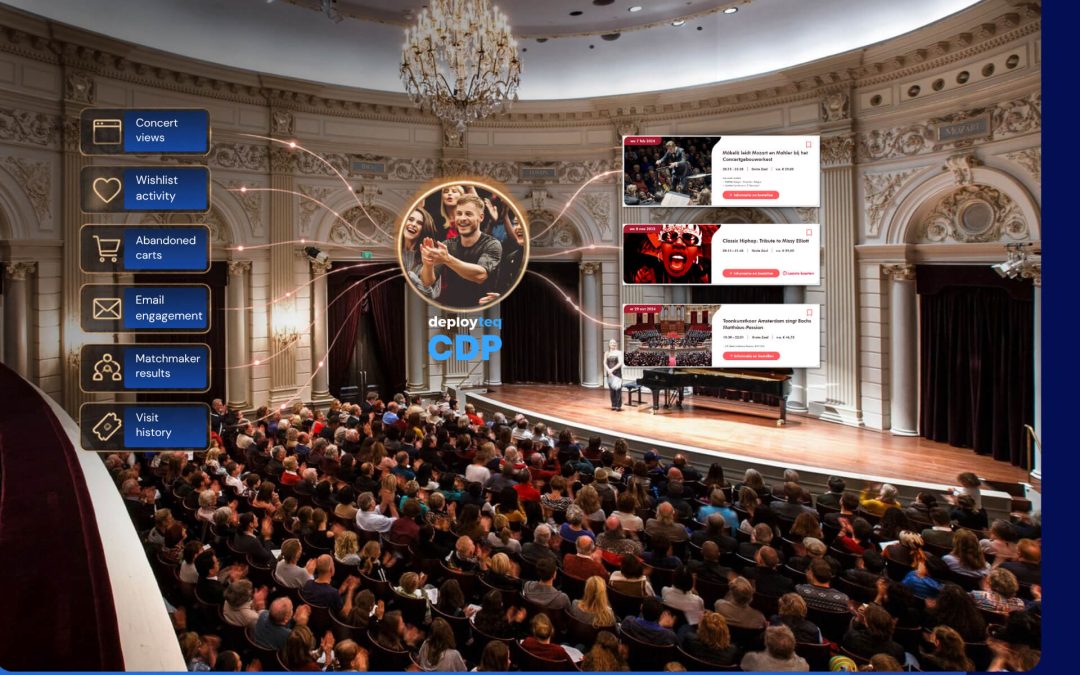
- 360-degree single customer view: All your customer data, from purchase history to web behaviour to email engagement, unified into one intelligent profile.
- Intelligent modelling built in: RFM scoring, next-best-offer logic, and full lifecycle insights are available directly within your campaign workflows.
- Seamless cross-channel activation: Build a segment and deploy it instantly across email, SMS, WhatsApp, push, and web, all from within Deployteq.
- Hyper-personalised campaigns at scale: Use real-time profile data to trigger messages that match where each customer is in their lifecycle, not just what list they are on.
- Marketer-first design: No data science degree required. Our platform is built for CRM managers, marketing managers, and CMOs who need to move fast.
If your data is ready to work harder for your campaigns, book a demo and see what a unified customer profile can do for your results.