The Challenge
As one of Europe’s busiest travel hubs, Schiphol Airport faces the daily challenge of keeping millions of passengers on schedule, while keeping them informed and delivering an overall excellent customer experience. The airport had long been sending flight updates via its app through push notifications, but with increasing demands for reach, personalisation, and speed, the team saw a gap in how they could better support travelers, especially those not using the Schiphol app.
Two major communication needs emerged:
1. Improving access to flight and travel information through more commonly used channels, like WhatsApp, which is widely adopted by international travellers and therefore significantly increases reach. Along with existing in-app messages (through Schiphol app).
2. Expanding the ability to deliver time-sensitive messages, such as delays, disruptions, or operational alerts, to the right audience within minutes.
Beyond channel reach, the existing technical setup lacked scalability and flexibility. It required substantial internal development to manage message logic, personalise content, and adapt to differences across channels. Even more critically, time-sensitive emergency messages were sent to every device in the database, including people who were not flying that day or were not anywhere near the airport, a major precision and relevance challenge.
To improve the passenger experience and reduce operational load, Schiphol needed a system capable of reliably sending flight updates and emergency alerts quickly, while reducing internal responsibility and unlocking extended functionality, including profiling, personalisation, and more control over message formats.
The Solution
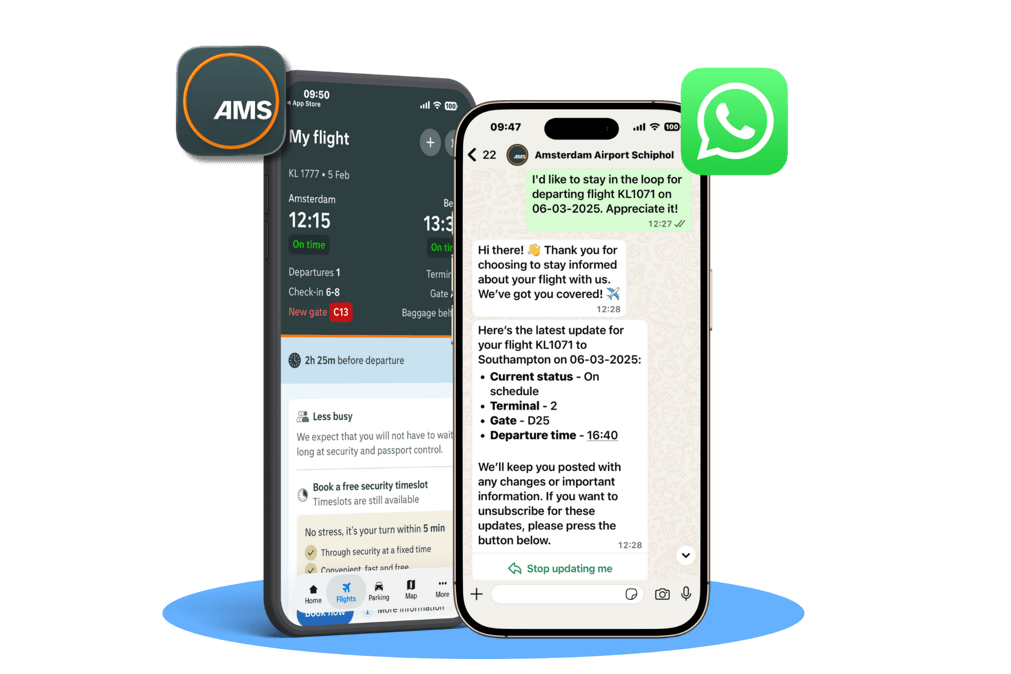
Schiphol launched a two-channel communication upgrade, adding WhatsApp messaging alongside their existing push notifications, to proactively inform passengers based on real-time flight data.
The strategy focused on:
Flight-specific updates: delivered within minutes, personalised messages about delays, gate changes, and boarding times.
Time-sensitive messages: delivered within minutes, emergency alerts in case of major disruptions (e.g. fire, train outages), delivered immediately to affected users.
Service messaging (in development): context-aware offers like food or shop suggestions once a traveller clears security.
The key was to make communication channel-agnostic while maintaining flexibility per channel. For example, WhatsApp messages needed to remain concise and conversational, while app push messages could carry more visual or contextual depth.
How Deployteq Made It Possible
Deployteq, already a trusted partner for years, was choosen for its ability to orchestrate complex, real-time communications at scale. Together, Schiphol and Deployteq built a solution that integrated seamlessly with the airport’s ecosystem of APIs and data sources.
Key capabilities included:
Dynamic data modelling: Deployteq’s platform connected directly with Schiphol’s flight database, storing subscription data for each user and flight.
Trigger-based automation: Campaigns automatically detect flight changes and send personalised messages only when relevant, avoiding message fatigue or duplication.
Channel-specific logic: Separate flows were created for push and WhatsApp, allowing messages to be tailored while maintaining a unified strategy.
Smart segmentation: In-app users are identified by behavioural triggers (e.g. passing security), allowing Schiphol to time service messages with precision.
Meta WhatsApp integration: WhatsApp templates were approved via Meta and managed from Deployteq, with logic built in for multi-language support and dynamic fields.
For emergency messages, Schiphol has implemented Firebase Topic Messaging, allowing Deployteq to push alerts instantly to large device groups, without needing to render or calculate messages individually.

The Results
- 777,345+ conversations via WhatsApp since launch in February 2025
- Capturing 2k unique users per day
- Nearly 3 million messages sent via Schiphol whatsapp app
- Passenger Satisfaction (PSAT) score: 4.4 / 5
- Positive internal feedback from operational teams, who noted a drop in travellers seeking in-person support during disruptions
Learnings & Takeaways
Reach matters: Travellers from outside the Netherlands are less likely to download the Schiphol app but are highly responsive to WhatsApp. Multi-channel options significantly improve accessibility.
Timing and tone matter with Personalisation: For example, for time‑slot reminders, we set a business rule that triggers a push notification between 18:00 and 21:00 the evening before a flight. Within that window, the device, chooses the ideal moment to deliver it. This ensures travellers receive the reminder when they’re still relaxed and preparing, not already stressed on their way to Schiphol. The result: a perfectly timed nudge to book their time slot.
Trust first, promotions second: By building credibility through helpful, timely updates, Schiphol is creating space to explore personalised service offers without overwhelming users.
Speed is critical: Operational success was measured not just in content delivery, but how fast it arrived. Deployteq enables message dispatch within a few minutes of a data trigger.
“The feedback has been overwhelmingly positive. From passengers following their elderly parents’ flights to teams on the ground who can now direct fewer confused travellers, this is already making an impact.”
Exciting upcoming feature: Live activities
Schiphol is currently developing Live Activities to surface essential flight updates directly on a traveller’s lock screen throughout their journey. From gate changes to boarding status, passengers will have real-times updates on their lock screen!